When people see MiniMinds, everyone asks what it does.
Almost no one asks how it works.
Which is funny, because how it works is the entire company.
In 2026, you can stand up an "AI agent" in an afternoon. Take an agent framework off the shelf, write a personality prompt, plug in a hosted memory API, rent a turnkey voice widget. Ship it Friday.
You can tell which apps did, because they all feel the same.
The same polite chatbot. The same goldfish memory. The same voice that sounds like every other app's voice, because it is every other app's voice.
Here's the thing about the problem we're solving.
An AI creator isn't a chatbot with a personality prompt.
It's a person.
A person has a voice. Their actual voice. A worldview. A way of talking. And most importantly, a separate relationship with every single fan. It remembers your kids' names, the thing you were worried about last month, the joke from three calls ago.
Nobody sells that off the shelf.
So we built it.
It started with NeuralGraph, the memory engine I was building while Aaron was building MiniMinds. A graph of what the AI knows about you: the people in your life, the threads of your story, the things that make a memory surface at the right moment. When we made it MiniMinds' brain, we did something counterintuitive.
We made it less flexible.
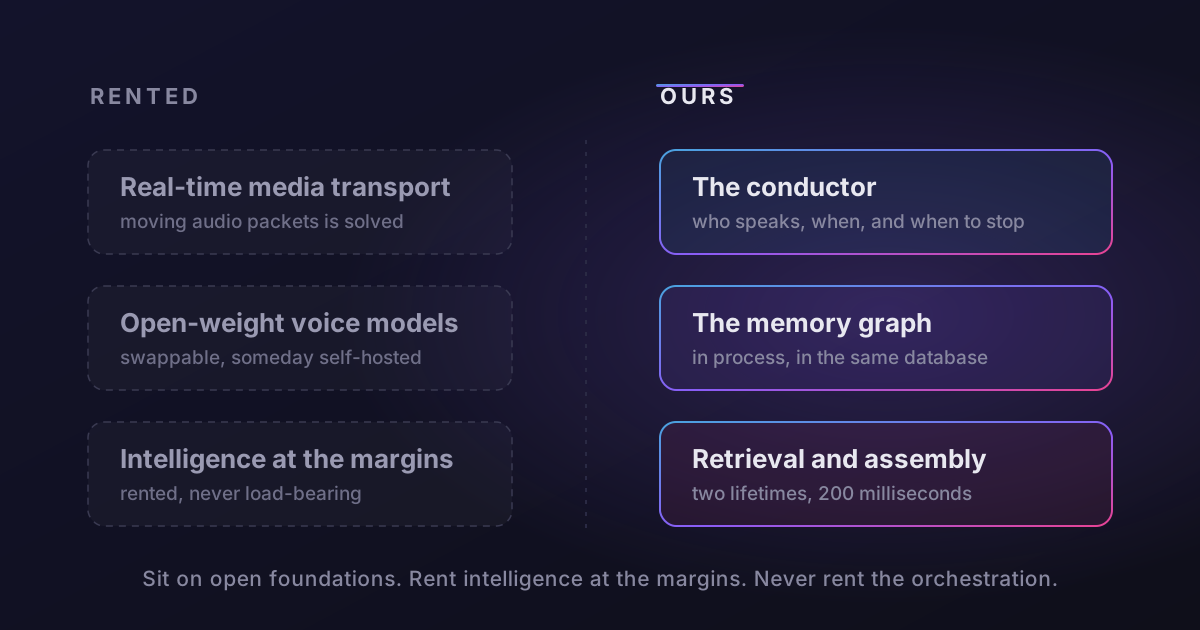
NeuralGraph was a platform: pluggable everything, its own service, a dedicated graph database. MiniMinds needed exactly four kinds of memory: who you are, who the persona is, what exists between you two, and what the persona knows. So we distilled the engine and moved it inside the backend. Same process, same database, graph traversal in plain SQL, microseconds from the conversation instead of a network hop away.
Every principle survived. The flexibility didn't.
That's what custom means. Not more machinery. The right machinery, and nothing else.
Voice is where it gets interesting.
We rent what should be rented. The real-time plumbing rides an open-source media stack you'd recognize, the one half the industry's voice agents ride. Moving audio packets is a solved problem, and rebuilding solved problems is vanity.
But the mind of a call is ours, top to bottom.
Put three personas and a fan on one call and no framework has a feature for what happens next. We built a conductor. One persona runs the room. The backend decides who speaks, in what order, and enforces the one rule the whole system bends around: only one voice talks at a time.
But the conductor isn't just a traffic cop.
It's reading the room.
It notices when two personas are piling on and tells one to back off. It notices when you've gone quiet in a way that doesn't feel like thinking. It hears you interrupt and actually stops, mid-sentence, and remembers only the words you actually heard, not the ones it meant to say. And it's listening for lines that shouldn't be crossed, ours or anyone's, ready to steer the conversation somewhere better.
A group call isn't a queue of chatbot replies.
It's a hosted conversation. Someone has to host.
And what are those voices actually saying?
Every reply is assembled in the instant between you finishing a sentence and the persona drawing breath.
In that instant, the backend reaches into two lifetimes. The creator's: their story, their convictions, the exact way they phrase things. And yours: what you've shared, what's been weighing on you, the things only the two of you have talked about. The words you hear are built from both, every single turn.
When we first wired it all together, that lookup took almost three seconds.
Three seconds is nothing in a chat window.
On a phone call, it's an eternity. Say something. One Mississippi. Two Mississippi. Three.
Nobody talks to that twice.
So I spent a week inside that one query. Profiling every step. Finding the index that was quietly reading everything instead of the one thing it needed. Rebuilding how the retrieval fans out across memory. By the end, the whole lookup ran in about two hundred milliseconds.
From three seconds to a fifth of one.
A pause becomes a breath.
Nobody will ever see that week.
Everyone will feel it.
The voices themselves were an architecture decision too. We build on the open-weight voice models that now top the closed ones on sheer fidelity, the ones the enthusiasts already know by name. Partly because they sound better. Mostly because open weights mean our ceiling is set by how well we direct a performance, not by a vendor's roadmap. We write stage directions, not settings. Someday those voices run on our own GPUs.
The exit was designed in from day one.
That's our whole posture in one sentence:
Sit on open foundations. Rent intelligence at the margins. Never rent the orchestration.
MiniMinds is the first thing this engine powers. It won't be the last.
Because strip away the creator economy, and look at what the machine actually does:
It lets you talk to an AI that actually knows things (real information, not vibes) and is someone while telling you.
That's not a creator feature. That's a shape of product.
A practice's companion that knows your history and sounds like your actual doctor's bedside manner. A coach that remembers every session you've ever had. A brand that answers in one consistent, human voice instead of a support script. A teacher with infinite patience and a personality kids actually want to talk to.
Same engine, every time: real knowledge underneath, a real personality on top, a memory of every person it talks to, and a voice on the phone that answers like a person, not a queue.
Creators are where we started, because creators are the hardest version of the problem. If you can make an AI hold up as a specific person their fans already know intimately... everything else is a smaller ask.
The engine is the company. MiniMinds is just its first stage.
Because when you take an agent framework off the shelf, you're not saving time.
You're renting your ceiling.
Everything your product can ever feel like is bounded by what the framework's authors imagined. And what they imagined is a chatbot.
We're not building a chatbot.
We're building people you can talk to, who know you, remember you, and sound like someone real.
Nobody sells that off the shelf.
So we built the shelf.
← Back to all posts